
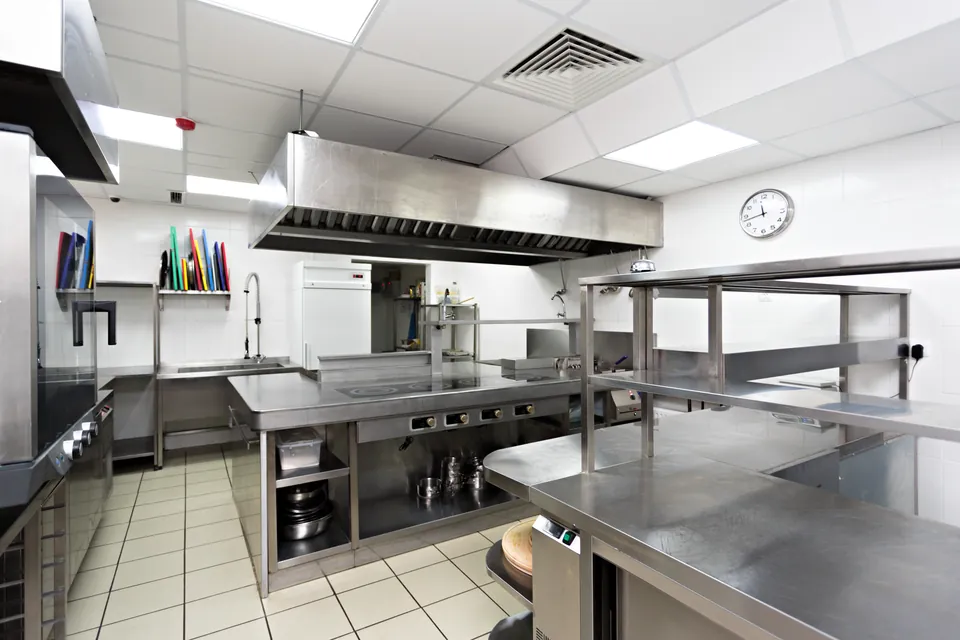
What is commercial kitchen deep cleaning?
Daily kitchen cleaning keeps a line running. Deep cleaning goes after what builds up anyway: grease on and behind equipment, food residue in corners and seams, soil in drains and floor sinks, and splatter on walls and ceilings near cooking areas.
A deep clean is a planned, top-to-bottom service, usually done when the kitchen is closed, that reaches the places a closing shift does not have time for. It supports health inspections, reduces slip and fire risks from grease buildup, and gives your staff a clean baseline to maintain.
6 Log Solutions provides commercial kitchen deep cleaning for restaurants, school and university cafeterias, healthcare and senior living kitchens, corporate food service and commissaries, using food-safe products and low-disruption practices. Services can be scheduled as a one-time deep clean, as inspection preparation or as part of a routine maintenance program.
What does a commercial kitchen deep clean include?
- Degreasing and cleaning cooking equipment: ranges, ovens, fryers, grills and steam tables
- Cleaning hoods, vents and accessible exhaust components (non-certified hood cleaning unless specified)
- Cleaning behind and beneath equipment
- Washing walls, backsplashes and surfaces
- Cleaning and sanitizing prep tables, sinks and work surfaces
- Scrubbing and degreasing floors, with edge detailing
- Cleaning drains, floor sinks and splash zones
- Cleaning shelving, racks, carts and mobile equipment
- Removing grease buildup from baseboards, corners and hard-to-reach areas
What is the difference between cleaning and sanitizing in a kitchen?
Cleaning removes soil: grease, food residue and debris. Sanitizing reduces the microorganisms left on a surface after cleaning. They are separate steps, and the order matters, because a sanitizer cannot do its job through a layer of grease.
The >FDA Food Code defines sanitization of cleaned food-contact surfaces as a treatment sufficient to yield a reduction of 5 logs, which equals 99.999%, of representative disease microorganisms. The word "cleaned" in that definition is the point: sanitizing assumes cleaning already happened.
In practice, that means wash, rinse, then sanitize food-contact surfaces, and follow the sanitizer label for concentration and contact time. If you want to understand what "5 logs" means, read what 6-log reduction means.
How does ATP testing fit into kitchen cleaning?
ATP testing checks whether cleaning removed organic residue. A swab picks up material from a surface, and a handheld reader measures adenosine triphosphate as relative light units. Higher readings mean more residue was left behind.
Kitchens are where the method started. CDC's >toolkit on evaluating environmental cleaning notes that ATP measurement has long been used to evaluate the cleanliness of food preparation surfaces. It measures both microbial and non-microbial ATP, so it does not identify specific organisms, and CDC notes that high concentrations of bleach can lower the signal, so surfaces should be dry before testing.
Good surfaces to test in a kitchen include prep tables, cutting boards, slicers and mixers, sink faucet handles, reach-in and walk-in door handles, and shared utensils. 6 Log's ATP cleaning verification follows a simple loop: baseline test, corrective cleaning where readings fail, retest and documentation.
Which kitchen areas are most often missed?
- Behind and beneath ranges, fryers and refrigeration units
- Wall surfaces and backsplashes behind cooking equipment
- Hood filters, vents and the areas around exhaust components
- Floor sinks, drains and the floor edges where walls meet tile
- Undersides of prep tables and shelves
- Door gaskets and handles on reach-ins and walk-ins
- Carts, racks and mobile equipment wheels
- Baseboards and corners where grease collects
What food safety rules apply to Colorado commercial kitchens?
Colorado retail food establishments operate under the state's Retail Food Establishment Rules and Regulations. According to >Jefferson County, Colorado adopted the FDA 2022 Model Food Code by reference as its revised regulations in January 2024, and the >Colorado Department of Public Health and Environment lists the current rules as effective March 16, 2024. Inspections are typically carried out by local public health agencies.
A deep cleaning program supports compliance, but it does not replace your own food safety practices. Your managers remain responsible for daily cleaning and sanitizing, temperature control and the other requirements in the code. What a periodic deep clean adds is a reset of the areas daily routines miss, and with ATP testing, documentation that shows how surfaces performed.
How do you prepare a kitchen for a health inspection?
Inspection readiness is mostly about consistency, but a focused push beforehand can catch problems that have crept in. A practical approach:
- Review your last inspection. Start with anything previously noted and confirm it has been corrected.
- Schedule a deep clean. Reset the areas daily cleaning misses, especially behind equipment, drains and hoods.
- Verify food-contact surfaces. ATP testing on prep tables, slicers and handles shows whether cleaning is removing residue, and gives you time to correct failures.
- Check your sanitizing setup. Make sure sanitizer is mixed and used according to its label and that staff know the procedure.
- Walk the kitchen with fresh eyes. Look at floors, walls and storage the way an inspector would.
A one-time ATP reset is designed for exactly this kind of inspection prep: baseline testing, corrective cleaning and documented retesting.
How should kitchen floors and drains be deep cleaned?
Kitchen floors take the worst of it: grease, food debris, water and constant foot traffic. Floors that look clean can still carry a slick film of grease, which is both a sanitation problem and a slip hazard.
A deep clean addresses floors in a specific order. Equipment that can be moved is pulled out so the floor beneath it can be reached. Loose debris is removed, then floors are degreased and scrubbed, with attention to edges, corners and the joint where walls meet the floor. Drains, floor sinks and splash zones are cleaned, since food residue collects in them and can cause odors. Floors are then rinsed and left to dry before equipment goes back.
Tile floors with grout lines hold onto grease over time. If grout has darkened, tile and grout cleaning can restore it as part of, or alongside, a kitchen deep clean.
What should you look for in a kitchen deep cleaning provider?
- Experience with commercial and institutional kitchens
- Food-safe procedures and products
- A clear written scope, including what hood work is and is not included
- Flexible scheduling, including after-hours and overnight service
- Detailed service documentation after each clean
- The option to add ATP verification on food-contact surfaces
How often should a commercial kitchen be deep cleaned?
There is no single right interval. It depends on your cooking volume, menu, equipment, hours and what your inspectors and internal audits find. A high-volume kitchen with fryers and grills builds up grease much faster than a cafeteria serving mostly cold food.
Most operators use one of three approaches:
- One-time deep clean to reset a kitchen that has fallen behind or after an ownership change
- Inspection preparation ahead of a health inspection or internal audit
- Routine maintenance program on a recurring schedule that fits your volume
ATP results can help set the schedule. If readings on the same surfaces start climbing between deep cleans, that is a sign the interval or the daily routine needs adjusting.
How do you schedule a kitchen deep clean without disrupting service?
Plan the deep clean for when the kitchen is closed. 6 Log works around your schedule to minimize disruption, including after-hours and overnight service options. Before the crew arrives, it helps to:
- Store or label food so equipment and shelves can be emptied safely
- Confirm which equipment can be moved and which needs a technician
- Clarify hood scope, since 6 Log's hood work is non-certified hood cleaning unless specified
- Share any recent inspection findings so the crew can focus there
Kitchens in schools, hospitals and food production facilities often bundle deep cleaning with other services. See food production and schools and universities.