What is the difference between terminal cleaning and turnover cleaning?
The difference is timing and scope. Turnover cleaning, also called between-case or end-of-procedure cleaning, happens every time one surgical case ends and the next begins. It is fast, focused and repeated many times a day. Terminal cleaning happens once, after the last procedure, and covers the entire room.
CDC's >operating room cleaning guidance lays out four touchpoints across an OR's day: before the first procedure, between procedures, after the final procedure (the terminal clean) and on a scheduled basis such as weekly or monthly. Each has a different job. Confusing them is how rooms end up with a rushed "terminal" or an over-scoped turnover that delays the schedule.
6 Log Solutions supports both ends: an OR Turnover Support Program for between-case work and operating room deep cleaning and disinfection for terminal and scheduled programs.
What does OR turnover cleaning cover?
CDC's >OR cleaning summary describes cleaning and disinfecting before and after every procedure, including:
- High-touch surfaces outside the surgical field, such as light switches and doorknobs
- Any surface visibly soiled with blood or body fluids
- All surfaces, noncritical equipment and the floor inside the surgical field
- Removing used linen, drapes, waste, suction canisters and filled sharps containers
Portable equipment such as compressed gas tanks and x-ray machines also gets cleaned and disinfected before and after each procedure.
The constraint is time. AORN's >between-case guidance focuses on the steps most likely to be cut short: keeping surfaces wet for the disinfectant's full contact time, cleaning from least soiled to most soiled, working top to bottom and using fresh cleaning materials for each room.
What does terminal cleaning of an operating room cover?
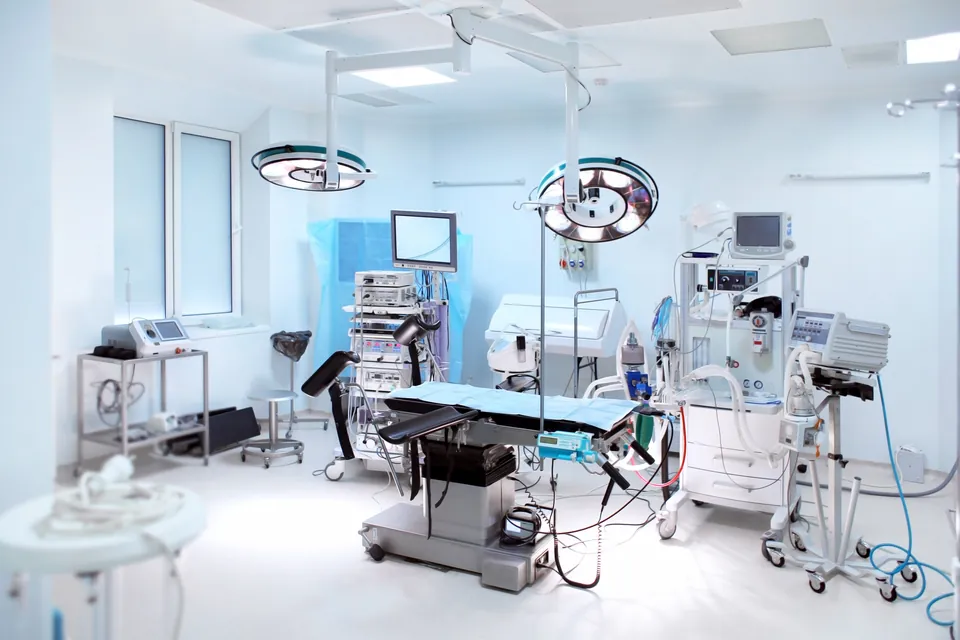
Terminal cleaning resets the whole room. According to CDC's >OR frequency table, after the final procedure staff clean and disinfect:
- Horizontal surfaces, both high-touch and low-touch, and fixed equipment, including booms and the wheels of carts
- Vertical surfaces such as walls and windows as needed to remove visible soil
- Ventilation ducts
- Handwashing sinks and scrub and utility areas
- The entire floor, including baseboards, with the operating table and mobile equipment moved to reach underneath
Portable patient-care equipment that is not stored in the OR, such as suction regulators, anesthesia trolleys and lead gowns, is cleaned and disinfected before it leaves the room.
The key difference from turnover is completeness. Nothing is "outside the scope" during a terminal clean, and the time pressure of the next case is gone.
What happens before the first case of the day?
CDC describes a short but important step before the first procedure: confirm from records that the terminal clean was completed the previous evening, then wipe horizontal surfaces such as furniture, surgical lights, the operating bed and stationary equipment with a disinfectant to remove dust that settled overnight.
If there is no written confirmation of a terminal clean, CDC's guidance is to perform a full terminal clean before the first case. That is a strong argument for documentation. A simple signed record of each terminal clean saves the morning team from guessing, and it gives infection prevention something to review.
What is scheduled OR deep cleaning?
Some surfaces do not need daily attention but cannot be ignored. CDC lists low-touch surfaces such as ceilings, walls and the insides of cupboards for cleaning on a scheduled basis, for example weekly or monthly, alongside the terminal clean.
A scheduled deep clean is the most thorough level. 6 Log's OR deep cleaning scope uses a low-dust, top-to-bottom method that includes ceiling tiles, vents, diffusers and light fixtures, wall washing, detailed baseboards and corners, equipment and booms cleaned per manufacturer guidelines, wheels and casters, auto-scrubbed floors, hospital-grade manual disinfection and a final electrostatic treatment. Each service ends with documentation: a scope checklist, supervisor sign-off, date and time, and optional ATP verification on request.
Facilities typically schedule this quarterly or on another set cycle, after construction or renovation, and before surveys.
Who performs terminal cleaning in the OR?
CDC's >OR cleaning summary lists shared cleaning between perioperative clinical staff and cleaning staff as possible for the before-first-case, between-case and terminal touchpoints. In practice, many hospitals assign terminal cleaning mainly to EVS, with clinical staff responsible for specific equipment under facility policy.
Whoever does it, terminal cleaning requires training specific to the OR. Staff need to know how to move and clean around booms and anesthesia equipment per manufacturer guidelines, how to keep disinfectants wet for the full contact time, how to work top to bottom and clean to dirty, and how to protect airflow by keeping dust down. Rushing a terminal clean because the night shift is short-staffed undercuts the whole next day, which is why some facilities bring in dedicated support for terminal and scheduled cleaning.
What mistakes blur the line between turnover and terminal cleaning?
The most common problems come from treating the two as interchangeable:
- Calling a quick wipe-down a terminal clean. If the floor under the table and equipment was not reached, it was not a terminal clean.
- Over-scoping turnovers. Adding terminal-level tasks between cases delays the schedule and creates pressure to cut corners on the steps that matter.
- Skipping documentation. Without a record, the morning team cannot confirm the terminal clean, and CDC's guidance then calls for repeating it.
- Forgetting portable equipment. Items that travel between rooms, such as x-ray machines and gas tanks, need cleaning before and after use.
- Letting low-touch areas slide. Ceilings, vents and walls drift without a scheduled deep cleaning cycle.
Clear definitions, written for your rooms and agreed with infection prevention, keep each type of cleaning doing its own job.
How do UV and electrostatic disinfection fit in?
Technology can add to manual cleaning, but it does not replace it. Two tools come up often in OR programs.
UV disinfection uses ultraviolet light on surfaces. In 6 Log's turnover program, targeted UV on defined high-touch zones is an optional enhancement, used only where appropriate and approved by the facility, applied according to manufacturer instructions and dwell times, and always as a supplement to manual cleaning. UV works best on surfaces it can reach directly, which is one reason manual wiping still comes first.
Electrostatic application charges disinfectant droplets as they are sprayed so they spread across and wrap around surfaces. In 6 Log's OR deep cleaning scope, a final electrostatic disinfection treatment follows hospital-grade manual wipe disinfection, not the other way around.
The order matters for both. Soil has to be physically removed before any disinfection method can do its job, so these tools belong at the end of a thorough manual process, never as a shortcut around it.
Which disinfectants are used for OR cleaning?
Product selection belongs to your facility's infection prevention team. What matters for everyone doing the work is using EPA-registered, hospital-grade disinfectants exactly as the label directs, including the wet contact time.
For spore-forming organisms such as C. diff, EPA maintains >List K, a list of registered products with laboratory data showing they kill C. diff spores, along with each product's contact time. Many routine disinfectants are not on that list, which is one reason facilities define when a sporicidal product is required.
6 Log's OR services use EPA-registered, hospital-grade disinfectants and low-dust practices to protect airflow, delivered in alignment with AORN guidelines, CDC infection prevention guidance, OSHA standards, and facility policies.
How do turnover, terminal and deep cleaning work together?
Turnover keeps the day moving
Between every case, a defined scope gets the room safely ready for the next patient without delaying the schedule.
Terminal resets the room
After the last case, the entire room and floor are cleaned and disinfected so the next day starts from a known baseline.
Scheduled deep cleaning reaches the rest
On a set cycle, ceilings, vents, walls and low-touch areas get the attention daily routines cannot give them.
Documentation ties it together
Signed records of terminal and deep cleans let the morning team and infection prevention confirm what was done.
Sources
- CDC, Environmental Cleaning Procedures (Best Practices for Environmental Cleaning in Healthcare Facilities in Resource-Limited Settings)
- CDC, Appendix B2: Cleaning Procedure Summaries for Specialized Patient Areas (same CDC resource-limited-settings guidance)
- AORN, Environmental Hygiene: Steps That Matter Most Between Cases (2026)
- EPA, Registered Antimicrobial Products Effective Against C. diff Spores (List K)